Olympia reborn: Inside a £1.3bn makeover for a 140-year-old icon
Andrew Busby · 25 September 2026 · 4 min read
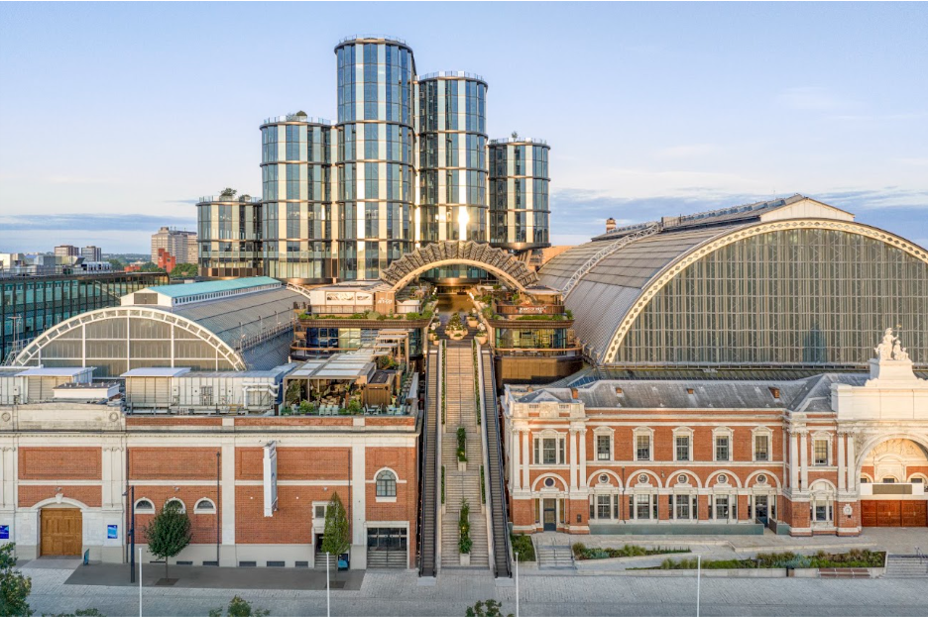
Image: Olympia
Opened in 1886 as a Victorian temple to spectacle - trade fairs, Vivienne Westwood’s first runway show, Pink Floyd and Jimi Hendrix under the same cast-iron roof - Olympia has spent 140 years being remarkable and mostly invisible: wheeled out for the exhibitions and locked away in between. Now, courtesy of Yoo Capital and DFI, and a masterplan from Heatherwick Studio and SPPARC, she’s been reborn, and some.
Andrew's Retail Reflections is a reader-supported publication. To receive new posts and support my work, consider becoming a free or paid subscriber.
The 14-acre site has gained 2.5 acres of new public streets, walkways and terraces. Its Grade II-listed halls, still capable of holding 20,000 people, never stopped working throughout construction. Alongside them sit two new hotels, the newly opened British Airways ARC, a 3,800-capacity music venue run with AEG Presents, plus a 1,575-seat theatre opening in 2027 - London’s largest to open in almost 50 years. Once complete, the site expects around 10 million visitors a year, contributing more than £600 million annually to the UK economy.
Walking the site with CEO Michael Volkert, the ambition and the sheer scale of what’s been achieved is striking. “It’s one of London’s largest regeneration projects,” he tells me, “a real labour of love trying to take a historic Victorian building, and bring that to the modern age.” The brief, as he puts it, was deceptively simple: “How do you better use that space? How do you create a mixed-use estate that really opens up to the people and isn’t just about the exhibition business?”
The answer was to build an entirely new estate on top of the old one - quite literally, in the case of the 550,000 sq ft of office space now sitting above the historic halls, complete with floor-to-ceiling windows and what Volkert calls “some of the largest terraces you’ll find in any building in London.” Stood among the new bars and restaurants on Emberton Walk, he makes the wider point himself: “It doesn’t feel like you’re in London anymore.”
Most tellingly, Volkert is refreshingly clear about what Olympia aims to be. “We’re really in the experience business. We focus every day on creating experiences, and Olympia is going to be different every day depending on why you’re here.” It’s a heretical line for anyone who’s spent a career fretting over footfall and conversion rates, and it might just be the most important one in this piece: a £1.3 billion vote of confidence that experience is the product now, not the marketing around it.
Down in the Grand Hall, Olympia Events’ COO Alex Lewis is wrestling a more immediate problem: what to do with a calendar that used to go quiet the moment exhibition season ended. His answer has been to fill the gaps with some imaginative events. A case in point being a major Padel tournament in August: “It was incredible - August is a very quiet month for our business, and it was a really good example of driving a completely different kind of business into this space.”
For Lewis, that blend of old and new is the whole appeal of the job. “All of us who are involved in this at the moment have got the absolute privilege of being at the birth of something genuinely exciting in London,” he says, “and for all of us in the events industry, that’s an incredible honour to have.”
He’s just as open about the balance between heritage and creativity. “One of the things about working in a building like this is that we spend a lot of time celebrating the Victorian architecture, and then someone comes along and says, ‘we’re going to cover all of that up,’” During Fashion Week, he explains, one brand spent four days building a set for a 23-minute show, covering the hall’s vast glass roof to create the dark, immersive setting the production required. “They had a very specific creative vision, and the end result was absolutely spectacular. It’s a great example of how flexible these halls are. You can celebrate the architecture or completely reinvent the space and transform it to suit your needs.”
Lewis’s bigger idea, though, is connectivity - clients taking the music venue as their plenary room, the new 800-seat auditorium as breakout space, the restaurants for catering, in what he calls “a sort of estate-wide takeover.” The ambition is disarmingly candid, too: “Part of our mantra here is wanting to be the host, not just the venue.”
What Volkert and Lewis are really describing is a mixed-use destination for everyone to enjoy, essentially a unique new conference and events venue that signals something new – despite being 140 years old.
First published in CityAM
Andrew's Retail Reflections is a reader-supported publication. To receive new posts and support my work, consider becoming a free or paid subscriber.